Introducing the English Enjoyed app

Master your English in ten minutes a day.

Vocabulary, grammar, and punctuation in formal British English, for people who already speak English well and want every word to be the right one.

Free for 14 days. No adverts, ever. Cancel at any time.

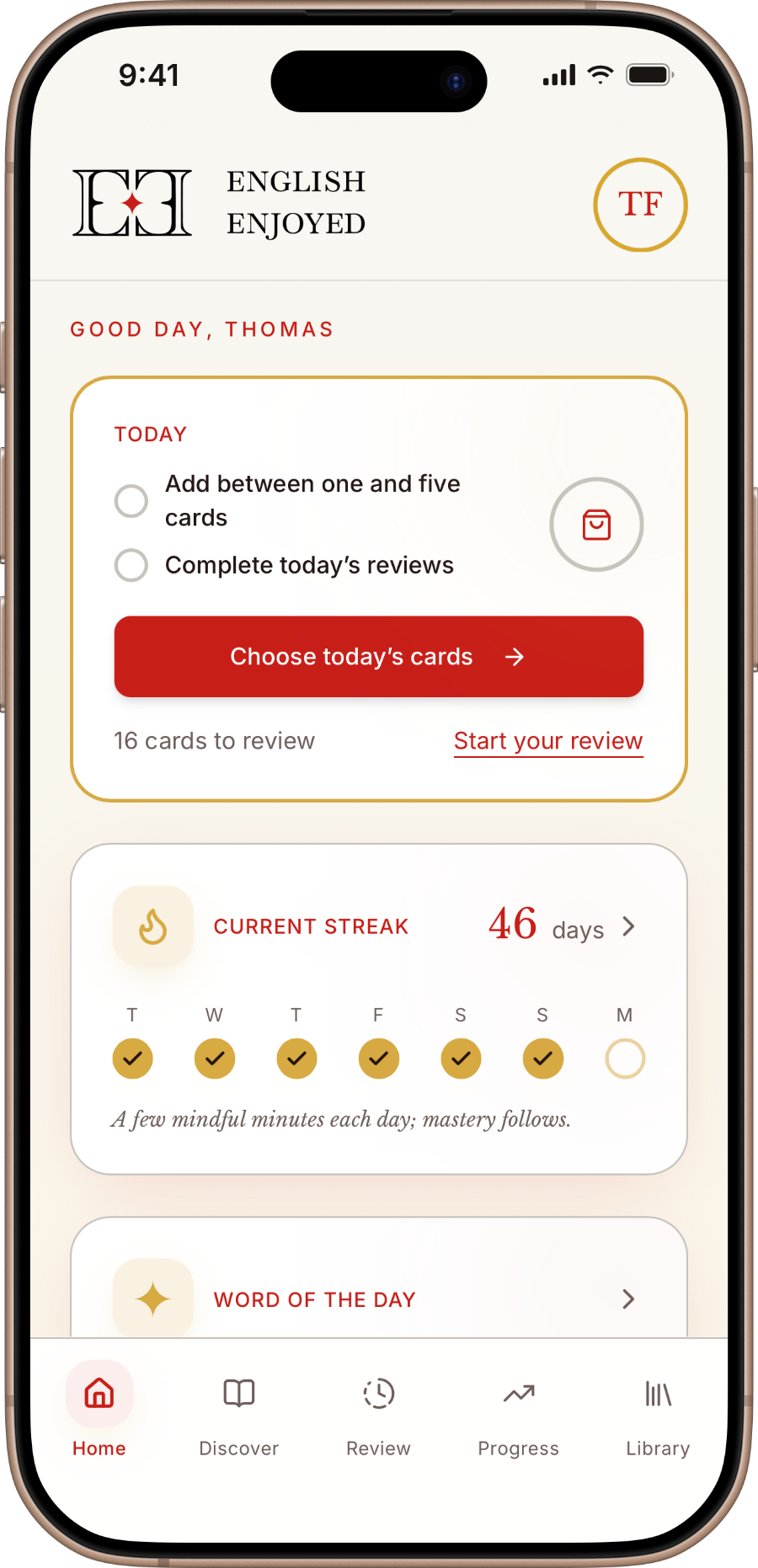
The English Enjoyed Home screen
5new cards a day
10minutes of reviews a day
1,825words and rules a year

The problem

You know the word.
It simply is not there.

I

Gaps

You read the news in English. You work in English. You dream in English. Then, mid-conversation, you reach for a word you are certain you have met before, and the shelf is bare. You settle for a synonym you do not much like, and you feel the gap.
II

Ruins

On Sunday evening you resolve to study for two hours a day. On Monday you are heroic; on Tuesday, diligent. On Wednesday a late meeting, a sick child, or leaves on the line intervene, and by Thursday the system lies in ruins. The system was never the problem. The ambition was.

III

Forgetting

Even when you do write the words down, or open the grammar book, it fails to stick. The notebook is never reopened, the rules go unrevised, and you recall none of it.

Vocabulary. Grammar. Recall.
So we built something to solve all three at once.

The Evergreen Method

Three principles for
everlasting English.

One · Spaced repetition

Meet each word just before you would forget it.

In 1885, Hermann Ebbinghaus measured how quickly we forget. About half of something new is gone by the next day, and most of it within a week.

Review a word at the moment you are about to lose it, however, and the memory does not merely survive; it strengthens. English Enjoyed calculates that moment for every card you hold. Recall it, and the card goes further into the future. Miss it, and you will meet it again sooner.

Each review comes a little later than the last: tomorrow, in three days, in a week, in sixteen days.

Two · Atomicity

One card holds one idea.

Piotr Wozniak, who wrote the first spaced-repetition program, called it the minimum information principle: simple cards are learnt faster, kept longer, and recalled more reliably than complicated ones.

So lead the metal and lead the verb are two cards, and a grammar topic is broken into its separate rules, so that each one is learnt cleanly and nothing is half-known for ever.

Three · Context

Words live in sentences.

We do not learn a word by staring at its definition. We learn it by meeting it in a novel, a conversation, or a film, surrounded by the context that gives it life. So every word comes with three sentences, each a different setting, and every review asks for the next. Try three: can you name each word before you show it?

Spacing, one idea, and context.
Everything that follows is that method, made beautiful.

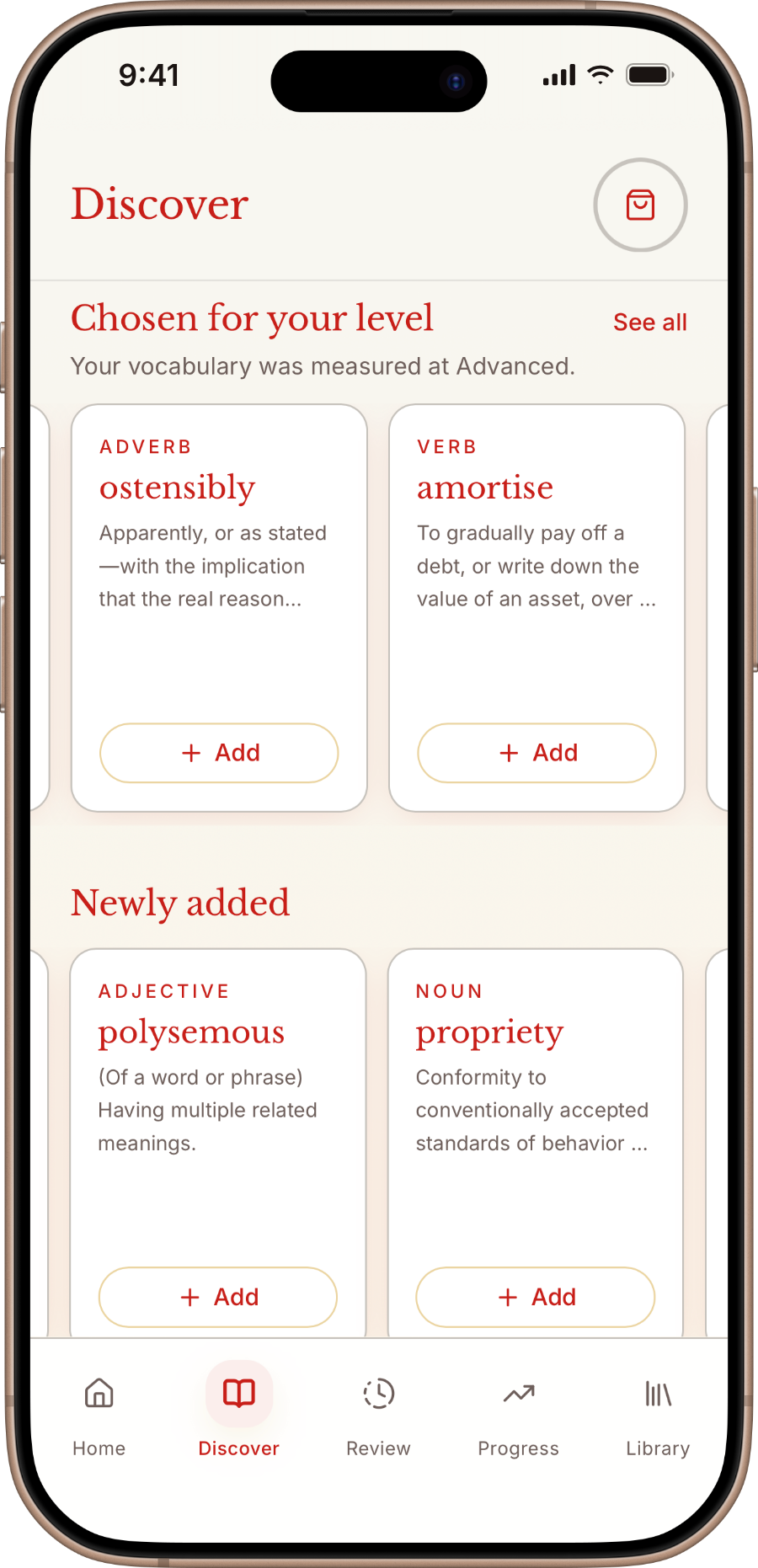
A closer look

Five tabs. One quiet ritual.

The Rule of Five

Five a day.
Not one more.

Five new cards a day keeps your reviews to about ten minutes. The Rule of Five is not a restriction upon your ambition. It is the protection of it.

Every review pile that has ever collapsed did so for the same reason. Somebody added ninety cards on a Sunday because inspiration struck, and by Thursday nine hundred reviews were waiting. Nobody opens that app again.

Five a day does not collapse. It is survivable in your worst week: the deadline, the flu, the house move. In a year, it comes to 1,825 new words and rules.

We call the daily habit the Refined Ritual: add between one and five new cards, then complete your reviews. On a busy day, one card is enough.

First meetings

Every new word,
met three times.

First, the word is introduced: its meaning, its sound, and a sentence. Then you meet it three times, with a little less help each time.

  1. Choose it from four.

    Your eye does some of the work while the word is still new.

  2. Type it, with the first letter.

    Shown how many letters it has and the letter it begins with.

  3. Type it, with the length alone.

    From the next day, it comes from memory, with a Hint should you need one.

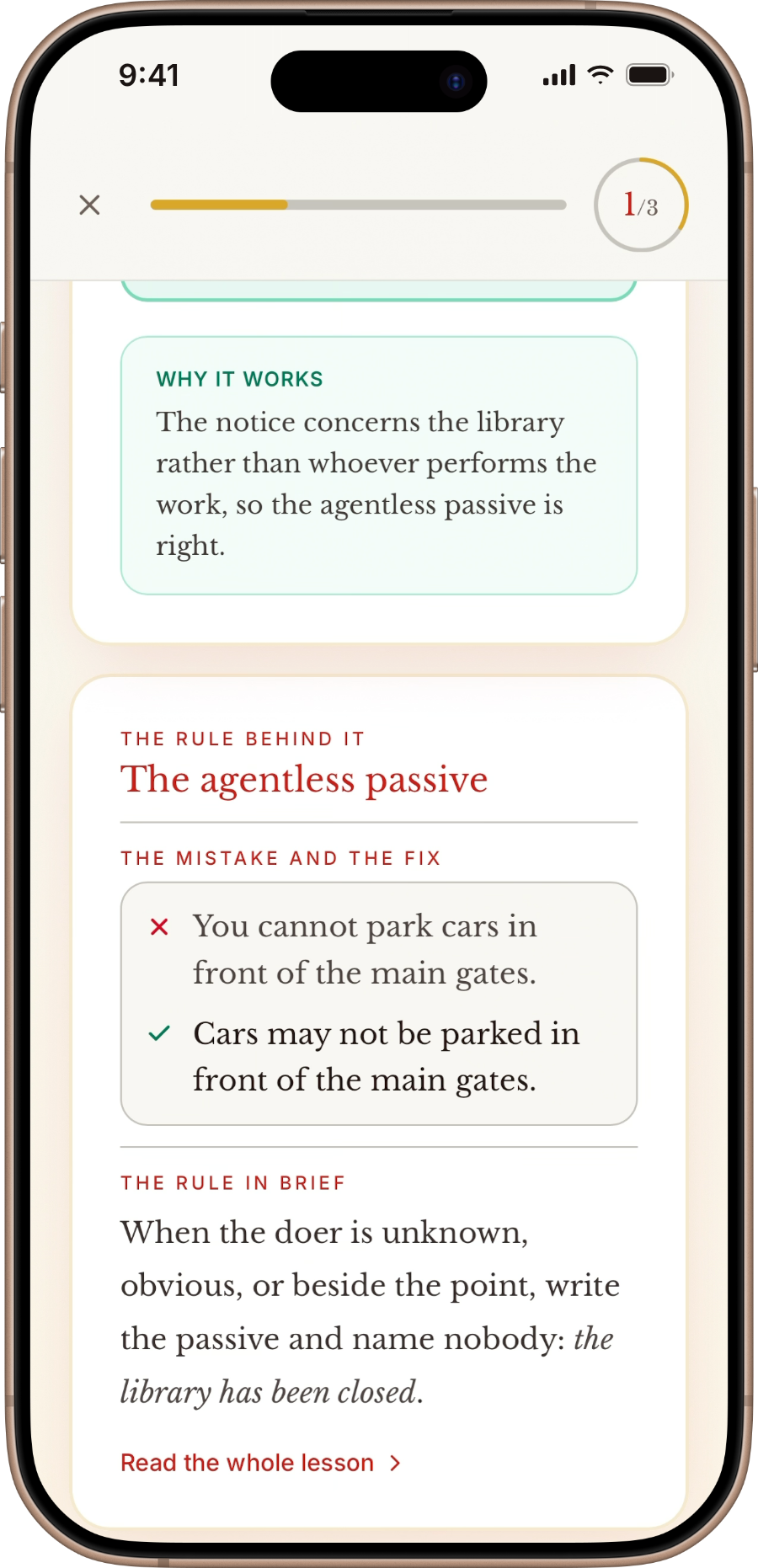
A rule begins with a question.

A new grammar or punctuation rule starts with a question, asked before you have read the rule. Answer as best you can: that first answer is never marked, and a confident mistake, once corrected, is among the best-remembered things there are.

Then the rule appears as two sentences, one with the mistake and one without, the rule in brief beneath them, and the whole lesson a tap away. Two more questions follow.

Review

The difficulty
is the learning.

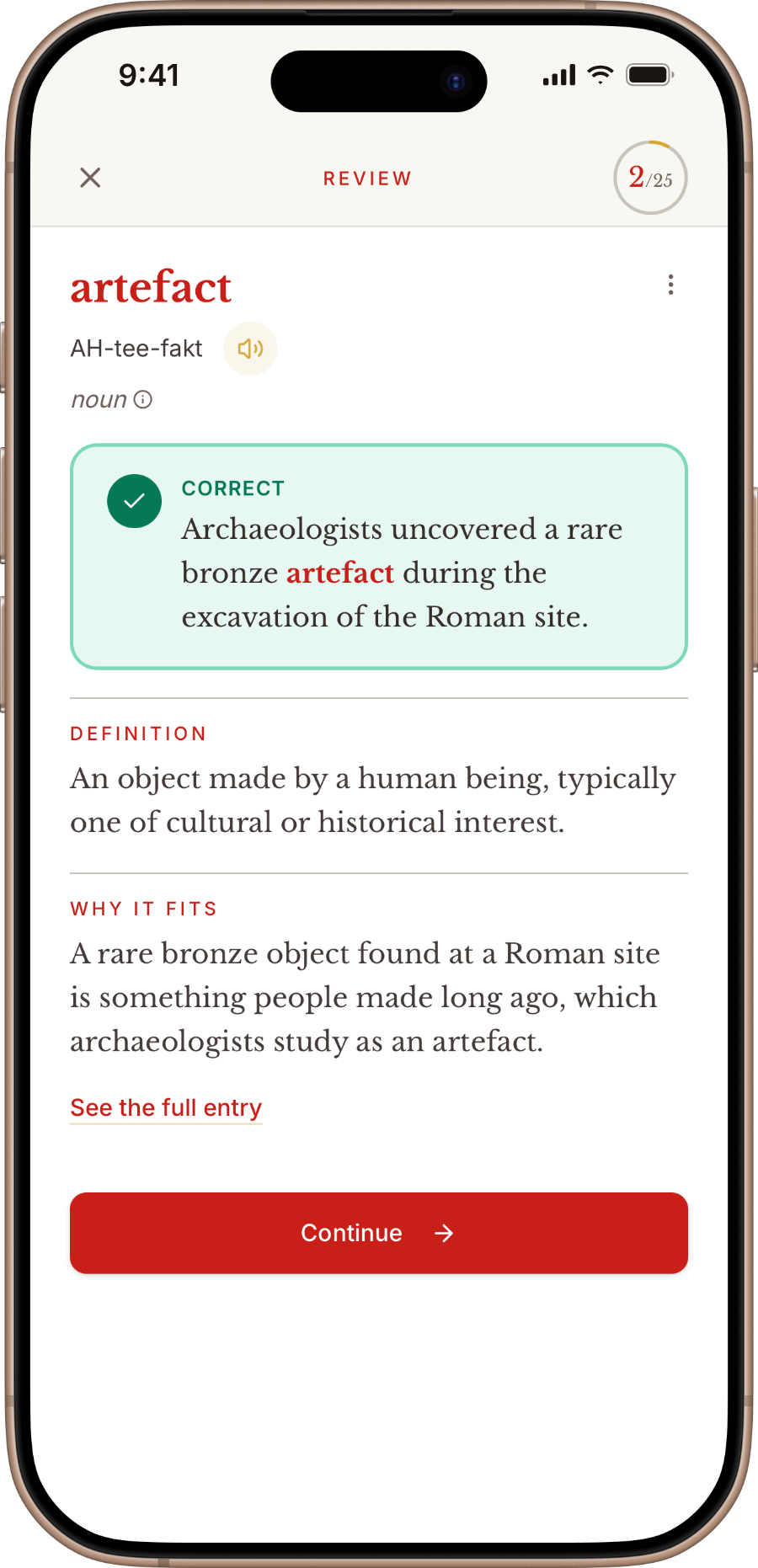
Mind the gap. Then fill it.

Almost every review is a sentence with one word withdrawn. We call it the Guided Gap. Beside it sits the word class wanted, and the rest you recover from the sentence itself.

Yes, it is difficult. Recognition is easy and fleeting; recall is hard and lasting. Stuck? Tap Hint for the meaning, then the number of letters, then the first letter. There is no penalty for asking.

A gallimaufry, on purpose.

In the real world, nobody has a vocabulary moment followed by a grammar moment. Language happens all at once. So Review mixes a verb, then a semicolon, then an idiom, and you cannot guess the answer from the topic. It feels harder, and that is why it works. Psychologists call it interleaving.

The Elevation

Mastered means
six months.

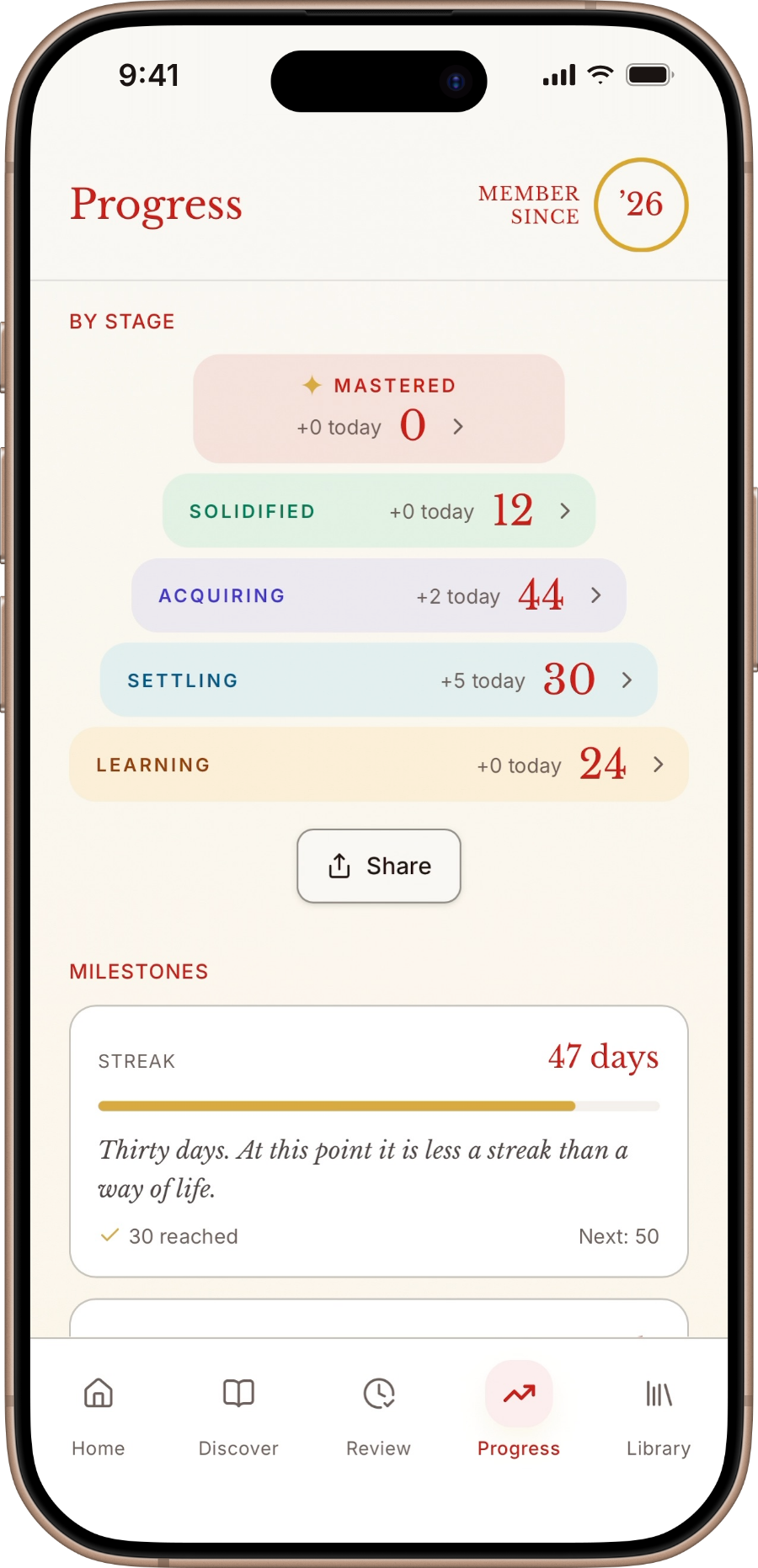
Every card stands on one of five stages, according to how long you would remember it without a single review: Learning, Settling, Acquiring, Solidified, and Mastered.

A card is Mastered only when the memory would last a full six months. Not six days, and not three right answers on a Tuesday.

We chose a demanding measure on purpose, because a number that flatters you is not a measurement. It is a decoration. There are no medals for mere participation here, and when that figure climbs, it means something.

Progress

An accountability partner, never a taskmaster.

In this century, we do not suffer from a shortage of information; we suffer from a shortage of accountability. Your streak and the Progress tab keep you on course.

A streak should be a reason to return, never a stick with which to beat yourself. Break it, and we shall not scold you. We shall simply be pleased to see you tomorrow.

Your Library

A library as
unique as you.

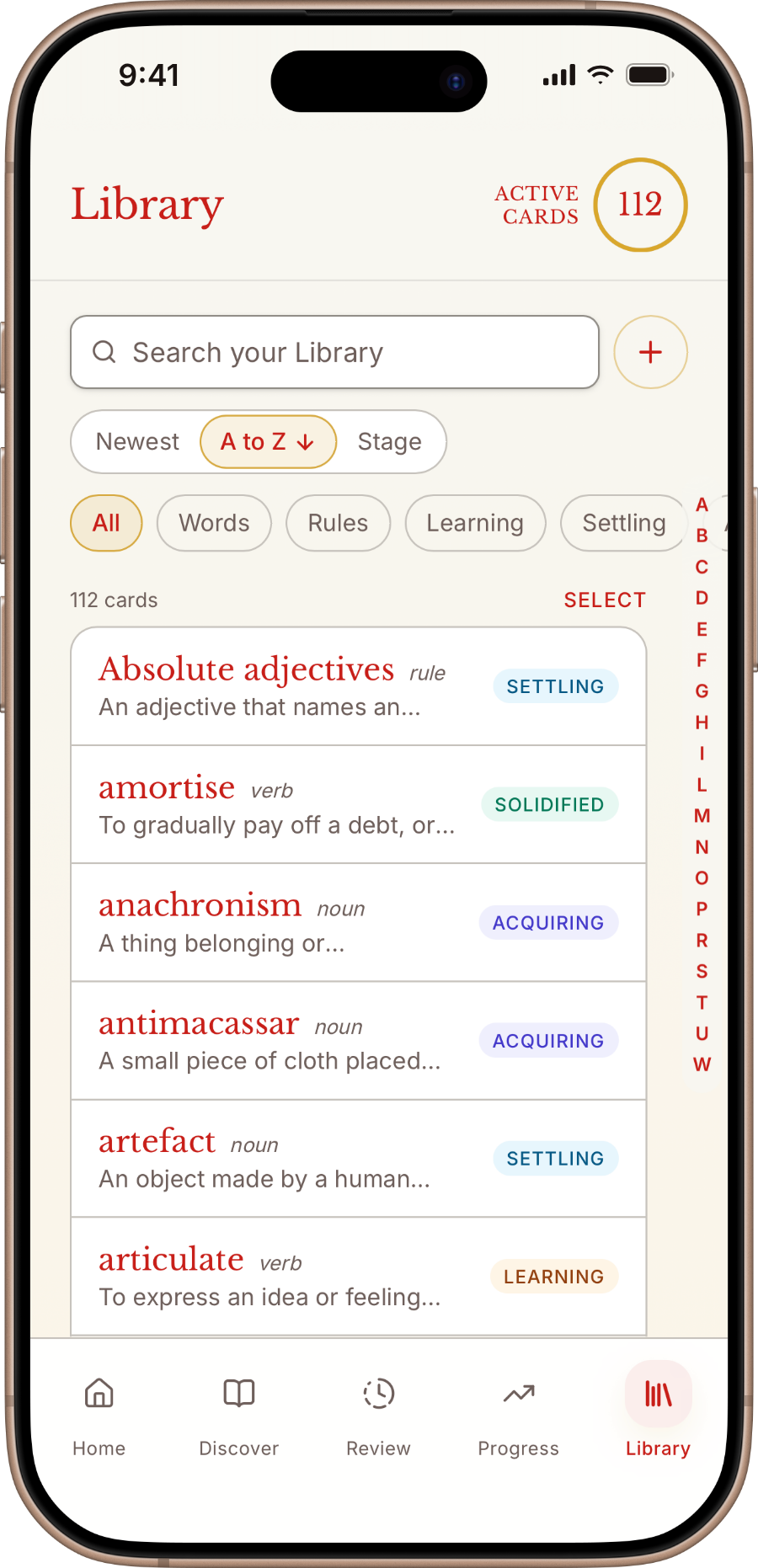
It is not a word list. It is a library, catalogued and assembled by nobody but you. Every card in it is there because you decided something was missing from your English.

Search it. Sort it by newest, A to Z, or stage. Open any card to read its definition, its rule, and its sentences.

Found a word in a novel? Add your own.

As you type, the app checks whether English Enjoyed already holds your word, with its definition, sentences, and audio. If so, take ours. If not, write your own, and it takes its place beside everything else.

The Library, searchable and sorted

Elocution

Hear it spoken.

A word you cannot pronounce is a word you will not use. Words are recorded in British English by a real person, the app’s creator, with more added every week. Tap once to hear a word, and again to hear it slower.

Anywhere

Learn on the Underground.

Download every word, rule, and recording to your device, and Discover and Review work without a signal: in a tunnel, on a flight, or in a cottage with no reception.

For the night owls

Beautiful after dark.

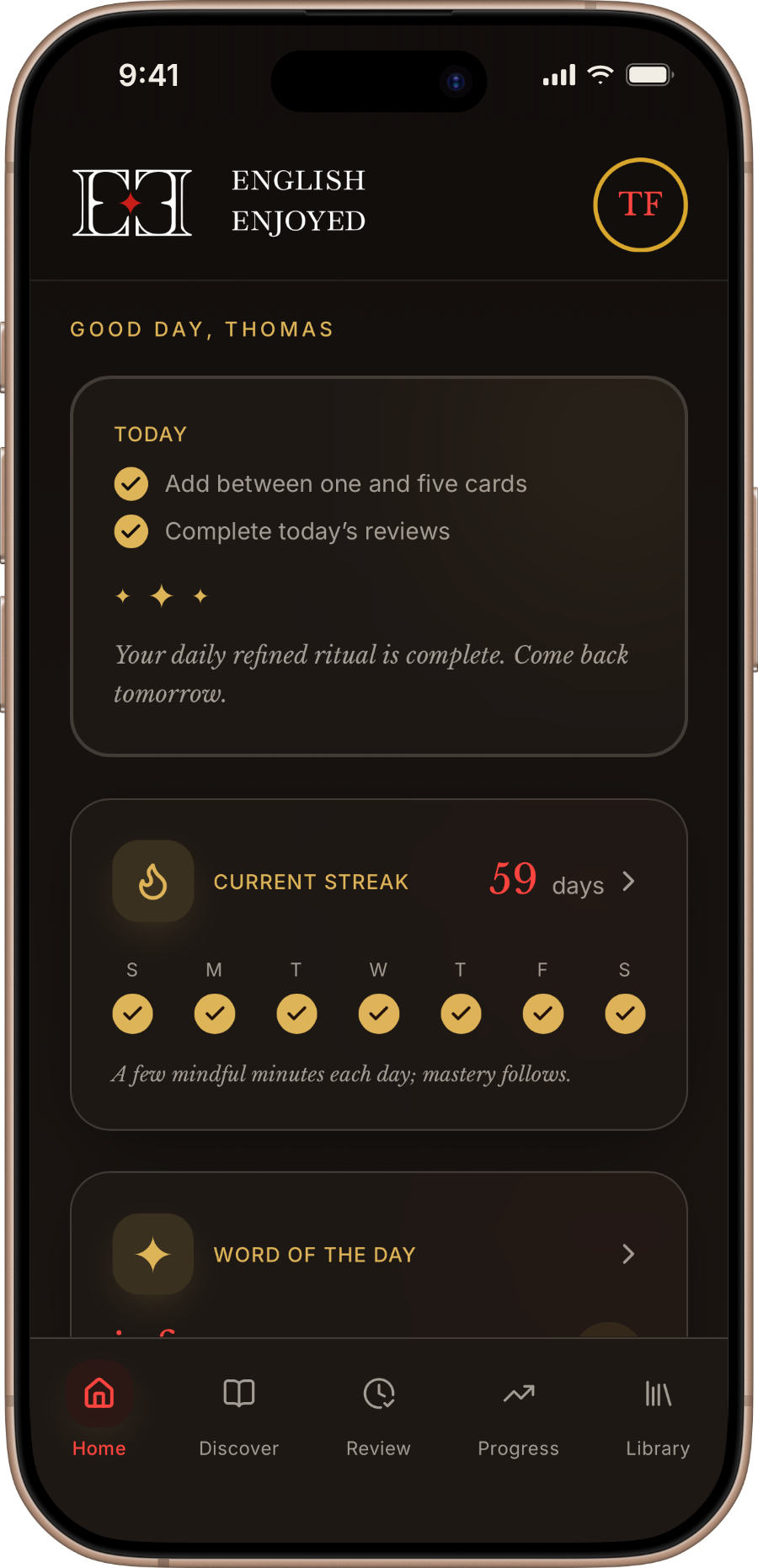
Every screen has been considered, reconsidered, and crafted to be as elegant as we knew how to make it. There are no adverts and no pop-ups: nothing stands between you and the next card. For late-night reviews, the whole app turns to a warm dark mode. You will open it every day for years, so it ought to be a delight.

The app in dark mode

What it is not

We handle the bricks.
You build whatever you like.

English Enjoyed will not replace your teacher. It will not replace conversation, films, novels, or the irreplaceable business of making a fool of oneself in a foreign language in a bar. Nothing replaces that.

What it supplies is the bricks: the words, the rules, and the expressions, the small, sturdy, interlocking pieces from which every sentence you have never said before will be built.

Thomas, creator of English Enjoyed

How I know it works

“One day, some months from now, you will be in conversation, and you will say punctilious, correctly, in context, without hesitation, and without the faintest recollection of having learnt it.”

I speak with some confidence, because this is not a method about which I have merely read. It is how I have improved my own French, Spanish, and English (yes, even my first language), and how I continue to do so, day after day.

ThomasCreator of English Enjoyed

Questions, answered.

Who is it for?

People who already speak English confidently and want the precise, formal British word: professionals, readers, and anyone who has felt the gap. It is not a course for beginners.

How much time does it take?

About ten minutes a day. You add between one and five new cards, then complete your reviews.

What is in it?

Vocabulary at three levels, idioms and expressions, British spellings, words that are easily confused, grammar, and punctuation, with new words added every week. A short run of real and made-up words at the start suggests where to begin.

How does the free trial work?

The first 14 days are free. We email you two days before the trial ends, and you can cancel in your App Store or Google Play account at any time before then without being charged. The price is shown in the store, in your own currency, before you start.

Are there adverts?

None, ever. Your subscription pays for the app, so nothing interrupts a review and nothing about you is sold.

Does it work without a signal?

Yes. Turn on Download everything to this device in Settings, and Discover and Review work offline.

Which devices does it run on?

iPhone and Android, from the App Store and Google Play.

Something is not working.

Write to support@englishenjoyed.com, and we shall put it right.

Come and build
your library.

One thousand eight hundred words and rules a year, held not in a notebook destined to be lost, but in the only repository that has ever mattered: your own long-term memory.

Free for 14 days. Questions? support@englishenjoyed.com